Showing posts with label Automotive. Show all posts

  The future of transportation is a fascinating topic that involves many innovations and challenges. Some of the trends and technologies tha...


The future of transportation is a fascinating topic that involves many innovations and challenges. Some of the trends and technologies that are shaping the future of transportation, such as 

Use of Smart Technology


This improves the future transportation using sensors, software and digital devices. This helps to improve efficiency and safety. As an example, real time traffic data analysis using satellites, smart system to find the parking system and improving the driver assisting maps. This gives better efficiency to reduce the traffic jam.


Use electric power sources


Many countries convert their vehicle to electric propulsion type. Because fossil fuels are major environmental pollution factor and it helps to reduce greenhouse gas emissions, air pollution, and noise. Currently, we have electric bus, train, bicycle and cars. In addition to that, lower maintenance cost is the best advantage.


Autonomous application


Currently, vehicle manufactures develop vehicles that can operate without human intervention. For that, artificial intelligence, and other smart devices are used to operate. Also, automated guided vehicle for parking system is another example for autonomous application in transport industry.


Below are the six potential Transportation ways,

Autonomous Aerial Vehicles (AAVs)


This refers small aircrafts which operate without human interference. These are similar to small drones, such as unmanned airborne vehicle for transport humans. These vehicles work with artificial intelligence (AI). AAVs use the advanced electronic system including GPS, navigation system and many of sensors. These AAVs are designed to take off and land vertically. Therefore, they do not need runways.


Also, autonomous ships will be introduced in the near future. Advance AI system is able to drive the autonomous ship using analyzed data of weather and sea currents. It will increase safety and efficiency i the maritime industry.


Delivery Drones- Drones are unmanned aerial vehicles (UAVs). Drones can deliver small packages to customers within short time period. Drones uses artificial intelligence with GPS, sensos and cameras and computer vision system to fly and find the dropped off  places.

The first unmanned drones delivered a food pack to the US resident in 2016. Nowadays, Drones are readily available in the US to deliver packages.

EHang 216 AAV


EHang 216 AAV


This driverless vehicle can travel up to 18 miles with speed of 80 miles per hour and 220 kg payload. This vehicles consist with eight propellers powered by 16 motors. The battery pack can be fully charged with two hours.


Hyperloop
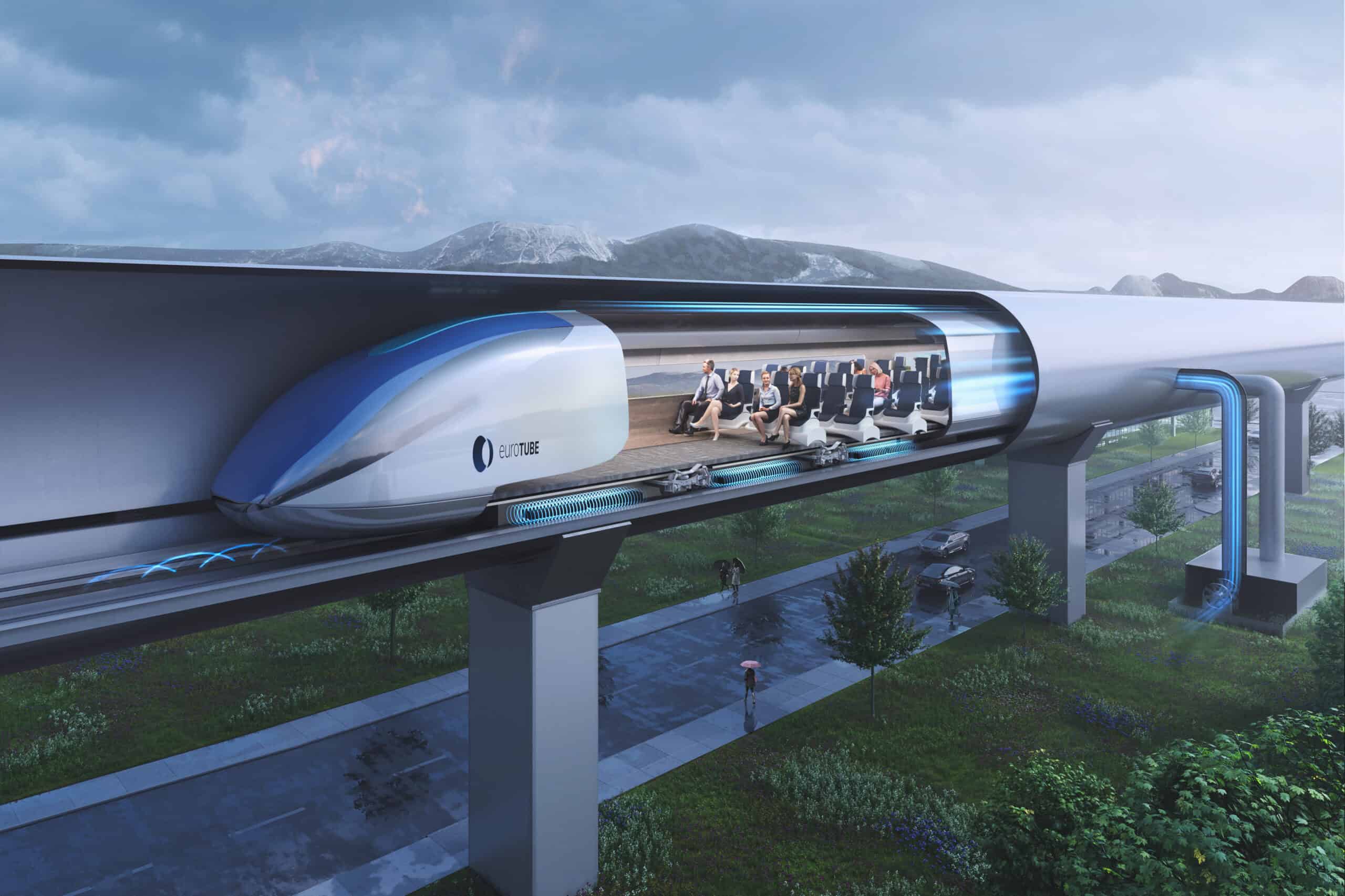

Hyperloop

Hyperloop can transport people at speed of 600mph and it is a transportation tube. This is a future creation and it is in design stage at the moment. For example, autonomous aerial vehicles, hoverbikes, and self-driving trucks can fly or drive themselves, and hyperloop can transport passengers and cargo at high speeds in vacuum tubes. A few companies in the World are working to realize this concept. This idea came from Elon Musk in 2012. This transportation method can be used to travel between cities, countries.


The concept of hyperloop is to carry people or goods using capsules or pods through tubes with low pressure environment void of air. Magnetic levitation (MagLev) technology is the propulsion system. Currently, designers use 500m test track in Apex, Nevada, called as DevLoop.


Flying Cars


Flying Cars


This is a perfect solution to reduce traffic congestion in the cities. In the future, we can see the cars over the heads. People will need a standard driver's license and some kind of pilot license to drive this car in the sky. The world's first flying car is Xpeng X2. This can travel 35 minutes for three-hour charge with two passengers.


Flying Taxis


Flying taxis mean small planes that will be used to transport people between cities. Most this kind of taxies are electrically powered and give safe and affordable transportation for people and goods.


Hoverbike


Hoverbike


The flying bikes are known as hovercycles. This is also vertical take-off  and landing (VTOLs) type aircraft. It has propellers and uses primary propellers to provide lift and uses smaller propellers to stabilize the Hoverbike.


Aerwins' XTURISMO Hoverbike has a hybrid propulsion system. It includes an internal combustion engine and four electric motors. It can manage a maximum speed of about 60 mph for 30-40 minutes.


Smart Infrastructure


Smart traffic light system


This can give more reliable information to future AAVs. This type of system can connect with all unmanned vehicle to update the traffic system.


Smart Roads

Smart roads have many features including sensors to gather data on traffic flow and public transit systems. Some countries includes solar panels to generate electricity when moving vehicles.

Electreon’s Wireless Charging Infrastructure

This is a wireless charging method using electreon. Electreon's wireless charging method works due to magnetic resonance induction by installing copper coils beneath the surface of the roads. Receiver mounted on the bottom of an electric vehicle catches the energy from the coils. This techniques can be placed on the public road and parking slots.


Shall we consider why a differential is needed for an automobile? A traditional differential is a gear train with three shafts that has the...


What are the Traditional Differential Types of vehicle?

Shall we consider why a differential is needed for an automobile? A traditional differential is a gear train with three shafts that has the property that the angular velocity of one shaft is the average of the angular velocities of the others. In automobiles, the differential allows the outer drive wheel to rotate faster than the inner drive wheel during a turn. This is necessary when the vehicle takes turns, making the wheel that is travelling around the outside of the turning curve roll farther and faster than the other.

Classification of differential in automobile applications

Automobile manufacturers have developed several types of differential in the world to achieve various tasks such as improving traction between tire and road and stability control. The following types are the most common types of differential in day automobile applications.


Open differential

Locking differential

Limited-slip differential

Torsen Differential


Open differential

The open differential is a type of differential that supplies the same amount of torque to each of the wheels of a vehicle

The open differential is a type of differential that supplies the same amount of torque to each of the wheels of a vehicle. The differential splits Engine torque into two output shafts. The output shaft can be rotated at different speeds.


Shortcomings of open differentials

Traction is determining the amount of torque that is supplied for the wheels. The engine can limit the amount of traction needed on hard. In slippery, wet or unstable surfaces, torque is applied so that traction can be achieved without risking slippage. When one wheel has steady traction and another is at risk of slipping, the differential divides the torque between both wheels, reducing the torque for the stable wheel to that of the slipping one. This has the disadvantage of reducing revolutions per minute (rpm) to zero.


Advantages

1. Great on roads
2. Predictable power distribution on the dry surface
3. Easy to drive and handle simplicity of design
4. Lower maintenance cost


Disadvantages


1. Poor off-road handling
2. Unpredictable power distribution on lower friction surfaces


Locking differential


The locking differential is an improvement of the open-type differential. A locking differential provides increased traction than an open differential by restricting each of the two wheels on an axle to the same rotational speed without regard to available traction or differences in resistance seen at each wheel. There are two types of lockers


1. Automatic locker
2. Selectable locker


Automatic locker


Automatic lockers lock and unlock automatically with no direct input from the driver. During ordinary conditions, when the vehicle is driving a straight road, the differential at “lock” state and if the difference between the speeds of the two rear wheels is minimal to the specified limit no signal will be generated by the electronic circuit. They will never allow either wheel to spin slower than the differential carrier.


Selectable locker


Selectable lockers allow the driver to lock and unlock the differential at will from the driver's seat. This can be accomplished in many ways. 


1. Compressed air (pneumatics).
2. A cable cable-operated mechanism is employed.


The shortcoming of locking differential

Locking the differential on a high-grip surface such as dry pavement makes it difficult to turn the vehicle. Increased tire wear and noticeable impact on driving behaviour. During cornering, which half-axle is uncoupled is dependent on the torque direction applied by the driveline. In selectable locker Mechanically complex with more parts to fail. Needs human interaction and forward-thinking regarding upcoming terrain.


Advantages


1. Traction is maximum due to both wheels providing high force with the same speed

2. Simple

3. Robust

4. No electronic controllers


Disadvantages


1. More expensive

2. Limited slip during engagement

3. Driver needs to manually engage

4. Some systems may be complex


Limited slip differential


Limited slip differentials (LSD) are used in vehicles to overcome the traction difference problem of drive wheels. Two types of limited slip differential are commonly used in automobiles.


1Clutch Plate Limited Slip Differentials
2. Viscous Limited Slip Differential


Clutch Plate Limited Slip Differentials


Apart from basic component in open differential there few special components they are steel plates (orange), friction plates (blue) and the casing as show in figure

Apart from basic components in open differential, there are a few special components: steel plates (orange), friction plates (blue), and casing, as shown in the figure. Friction plates are locked with side gears. Side gears and friction plats are always moved together.

Viscous Limited Slip differential


In this kind of differentials hydrodynamic friction from fluids with high viscosity is used to transfer engine power to drive wheels. Silicon base fluids are normally used as fluid. Here, a cylindrical chamber of fluid filled with a stack of perforated discs rotates with the normal motion of the output shafts.


Viscous limited slip differentials are less efficient than clutch limited slip differentials types because in this case lose some power.in case fluid is heated up very high temperature viscosity will reduce then the differential effect will stop temporarily or permanently.

There is an exponential relationship between torque transfer and speed difference. Therefore, it transfers a little torque at the initial stage of slip. To mitigate this issue, manufacturers adjust the final drive ratio by introducing pre-load the VC.

Advantages


1. Smooth torque transfer
2. Easy to drive
3. More proportional response due to slip
4. Limited "wind up" at low speed


Disadvantages


1. Fluid can break down with time
2. Less efficient than a conventional differential
3. Higher associated maintenance
4. Delay response due to viscous fluid is a flexible medium.


Torsen Differential

Torsen differential is a generous method provide differential affect and overcome traction difference problem. There some component rather than traditional open differential. There are six warm and wheel sets as shown figure.

The Torsen differential is a generous method that provides differential effects and overcomes traction difference problems. There are some components other than traditional open differential. There are six warm and wheel sets as shown figure.


When one wheel is a slippery surface that wheel tries to rotate at high speed. The wheel connected to a slippery wheel shaft trying to rotate the other warm wheel. But that warm wheel cannot rotate the wheel mesh with it. Finally, the whole system will lock. Then whole system rotates as one solid part. That means good wheels also get equal power same as slippery wheels. One drawback of the original differential was 50:50 torque distribution.

Advantages

1. Mechanical Simplicity
2. Less maintenance
3. Continuous Torque Transfer
4. No need for driver input


Disadvantages

1. High manufacturing cost
2. Limited slip but not locking
3. More complexity


What is an Electric Vehicle People use gasoline and diesel vehicles for their transportation. Traditional fossil fuel cars have internal com...


What is an Electric Vehicle

People use gasoline and diesel vehicles for their transportation. Traditional fossil fuel cars have internal combustion engines which are spark-ignited internal combustion engines for gasoline and compression-ignited combustion engines for diesel vehicles. In these types, the generated energy transfers to wheels through a mechanical transmission system. Mainly, fossil vehicles exhaust gases from the engine into the environment, which directly influences environmental pollution, and it has become a burning issue in the world. Also, there is a risk of the end of crude oil stock. Therefore, inventors were doing many activities to find alternative propulsion systems.


Electric vehicles are one of the best solutions recently and many car manufacturers are designing and manufacturing electric vehicles. Electric vehicles are commonly referred to as battery electric vehicles (BEVs), have low running costs and are environmentally friendly. Electric vehicle has electric motor instead of combustion engine, and large battery pack to power the electric motor. Due to the use of electric power, emissions are zero. Also, it does not contain the typical liquid fuel components of a normal combustion vehicle, such as a fuel tank, fuel pump, fuel pipes and exhaust system. The electric vehicle industry is still growing around the world.


Also, Plug-in Hybrid Electric Vehicles (PHEVs) and Hybrid Electric Vehicles (HEVs) are semi-electric vehicle types. However, those types are equipped with internal combustion engines. Semi-electric vehicles are the most popular versions in the current vehicle market.


Key components of EV

Battery pack

The battery pack is the most important, and heart of an electric vehicle. Electric vehicles use battery packs to store electrical energy to propel the vehicle. The battery pack contains a series of battery cells that are grouped together as modules. After the battery is charged sufficiently, it provides the required power to the relevant components. Lead acid or metal hydride batteries are used for some EVs. However, battery technology improves day by day, modern EVs use Lithium-ion batteries, because they have a very low self-discharge rate for a few days, even weeks.


Electric Motor

Electric motors convert battery energy to mechanical energy to power the vehicle. EVs have one or more motors which are highly efficient and minimum maintenance. Also, there are motor generators to propel the vehicle and to regenerate the power back.


Power Inverter


The inverter converts the direct current (DC) battery power to alternating current (AC) to drive the elective vehicle. Also, inverters manage the speed of the motor by changing the frequency of the alternating current. In addition, it can maintain the flow of power between the motor and the battery, including regenerative braking.

Onboard Charger

The onboard charger maintains the external AC electricity power to charge the batteries by converting them into DC electricity power. It monitors the characterization of the battery, such as temperature, voltage, current and charging status.

Thermal Management System

A thermal management system maintains the temperature of the battery pack and critical components during the operation. This system contains coolants which circulate through pipes and pump across the battery pack, electric motor, power electronics, and other components. This helps to maintain the right temperature for high battery performance and the life of the battery.

Electric Power Control Unit (PCU)

The power electronics controller helps to manage and control the flow of electrical energy between the battery, electric motor, and other components to control the speed of the motors. Furthermore, it functions to control the rate of charge using information from the battery. Simply, it changes the speed and performance of the vehicle.

Transmission

EVs use a single-speed transmission to transfer mechanical power from the electric motor to propel the vehicle. Some EVs have multi-speed transmissions. Electric motors can provide a wide range of torque.

Regenerative Braking System

Regenerative brake converts some of the kinetic energy during deceleration and braking into electrical energy to recharge the battery.

Electronic Vehicle Controller

The electronic control unit manages various parameters of the vehicle including acceleration, braking and energy management. This is also called the brain of the vehicle. It is operated by software.

High-voltage wiring and Connectors

Electricity flows through high-voltage wires and connectors from the battery to the motor and other components.

Vehicle Charging Port

Charging port allows to connect with external power source at stations or home.

How EVs works


Electric vehicles have forward and reverse modes according to transmission selection. When putting the vehicle into gear position and pressing the accelerator pedal, the vehicle moves. So, the power inverter converts DC power from batteries to AC power for the electric motor. Electronic Vehicle Controller adjusts the vehicle speed by changing the frequency of the AC power according to the accelerator pedal. When pressing the brake, the car decelerates, and the motor starts to operate as an alternator to charge the batteries.


Advantages

Noise is very low

Zero emission

No additional mechanical components, such as exhaust, IC engines, gears

Lower operating cost due to fever mechanical components

High energy efficient


Limitations

Rechargeable time is higher

Low driving range

Lack of charging stations

Higher battery replaces the cost


Future trends

As per technology development, many manufacturers try to resolve the issues daily. The battery industry grows rapidly around the world. Many of the world's leading car manufacturers invest more money to invent new technologies to make electric vehicles an increasingly popular and practical choice for many consumers. 

Another big news is the Hydrogen Fuel Cell based vehicle industry. In this type, hydrogen is used to power the motors. This is also still an upcoming technology, and few car models were manufactured for testing purposes. The Honda car manufacturing company has developed and produced the world's first government-certified commercial hydrogen fuel cell vehicle.


  What is an Anti-lock braking system? Anti-lock braking system, commonly known as ABS is a safety feature in modern vehicles. It helps driv...


What is an Anti-lock braking system?

Anti-lock braking system, commonly known as ABS is a safety feature in modern vehicles. It helps drivers control their vehicles during hard braking or emergency stops. ABS works with a regular brake system to prevent the wheels from locking up and skidding which involves to loss of steering control and accidents.

Anti-lock brake systems were initially tested for railway cars and aircraft in the 1950s. The world’s first Formula car was incorporated with the ABS system in the 1960s. After that, Mercedes-Benz began to install the ABS system into commercial vehicles. After a few years back, they revealed technology. Then the ABS system was included in many cars.  Therefore, ABS is a standard feature of modern vehicles to enhance vehicle stability and control.


ABS is mainly effective in slippery conditions, such as rain, ice or snow which needs traction control. During the sudden stopping, there is a possibility to loss of traction between the tires and the road surface. It increases risks of skid and loss the control of steering. This leads to accidents. When such kind of situation, the ABS comes to the rescue.


Anti-lock braking system includes four main parts,


Main components of ABS system

Speed sensors

Pump

Valves

Controller


Speed Sensors

Speed sensors provide wheel speed in an Anti-lock braking system. These sensors are located at each wheel or differential. It takes action to provide speed when the wheels are going to lock up.

Pump

Pumps restore pressure back to the system when the valve releases the pressure from the brakes.

Valves

The valve in the system allows three positions to allow, block and release pressure on the brakes. In the first position, the valve passes pressure from the master cylinder to break through the valve opening. Secondly, the valve isolates the master cylinder and brake to prevent pressure from rising. Finally, the valve releases some of the pressure from the brake.

Controller

The electronic control unit (ECU) takes data and processes the data. Then it gives real-time commands to control the braking pressure according to the wheel-speed sensor data. This is known as the computer in the car.


How it works

In this system, the ECU always monitors the wheel speed through wheel-speed sensors for rapid deceleration. In this kind of situation, the wheels lock up. ECU knows that wheels cannot have such a kind of deceleration. Before the locking wheels, Wheels need to be stopped quickly to prevent accidents. The ABS controller gives commands to reduce pressure to the brakes until the wheel acceleration again and then increase the pressure until the wheels decelerate again. This is done very quickly before reducing wheel speed suddenly. This is happening to slow down the wheel speed at the same rate as the car.


Modulation of Brake Pressure: The special thing is that the electronic control unit can maintain the brake pressure of each wheel independently. This allows the maximum braking power to the car. The system rapidly increased and decreased brake pressure when necessary to prevent skidding.


Pulsating Brakes:  while operating ABS, the driver feels a pulsating or vibrating sensation through the brake pedal. This is a normal condition that indicates the ABS works correctly to prevent the wheel from locking up.


Steering Control: ABS helps to maintain the stability of the vehicle during the rapid braking through the ABS system. This allows steering control by preventing wheel lock-up.


Anti-Lock Brake Types

Anti-Lock Brake Types

Four channel, four sensor

This system has four individual sensors and four valves for each four wheels. System monitor all wheels separately. This is the best system and it gives maximum braking force to the vehicle. Also, Four-channel ABS system gives better traction control.

Three channel, three sensor

This system consists three sensors and three valves. Two front wheels have individual sensors and valves while both rear wheels have one sensor and valve. For rear wheels, it is positioned in the rear axle to monitor both wheels together. This system commonly can be seen on pickup trucks with four-wheel ABS. The front wheels can achieve maximum brake force due to sensors monitor front wheel individually. However, rear wheel are monitored together. Therefore, there is a possibility to only one wheel before lockup.

One channel, one sensor

This system only has one sensor and one valve for rear wheels. This is commonly seen in pickup trucks with rear ABS. The sensor is located in the rear axle. One-channel ABS system works same as the rear end of three-channel ABS. There is a possibility to only one wheel before lockup by reducing the braking effectiveness.


Advantages and Disadvantages of ABS

Advantages Disadvantages

Low wearing brake pads and brake discs

maintainance cost is high

Vehical can be controlled at heavy braking

high complexity of the system

avoid uneven tyre wear due avoiding lockup wheels

braking distance may vary on different surface conditions


Due to smooth braking conditions, vehicle is running smoothly
Enhanced Traction